
Click on Title to Expand………
Thursday 23rd April 2026 – Club Meeting – Speaker, Peter Cotton, with a presentation entitled ‘Nell Gwynn, a Cinderella of her time’.

Peter Cotton had produced a very detailed presentation about the short life of Nell Gwynn and it was in many ways a very positive homage to a girl from seemingly humble beginnings as an orange seller and subsequently a successful actress. Although she was one of 15 mistresses to Charles II, there was a remarkable loyalty between them that endured until his death.
Peter detailed her career which to some degree ran parallel with the development of The Theatre Royal and the era of social freedom and licentious promiscuity which followed the reformation during Charles II’s reign.
Peter listed some of the other mistresses that Charles enjoyed and highlighted their ‘given’ noble titles that the ladies and their offspring carried forward to their future generations. However some of these mistresses weren’t particularly like by the Royal Court and Nell called them names such as ‘Cartwheel’, ‘Squintabella’ and ‘The Italian Whore’.
Nell produced 2 children with Charles II, Charles Beauclerk and James Beauclerk who didn’t survive into adulthood. Charles Beauclerk was rewarded with the title of ‘Earl of Burford’ having inherited Burford House near Windsor from his mother after her death. Nell only survived Charles by 3 years and died aged 37 years. She is buried in the crypt of St. Martin in the Fields. Overall she was a very loyal servant of the king and enjoyed great popularity amongst the wider Royal Court.
Thursday 16th April 2026 – Walk – Dunham Massey
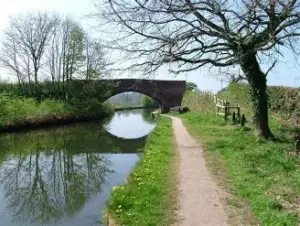
The walk in sunny weather commenced by walking up into Dunham Park where the Group witnessed an Ambulance crew attending a patient lying in the main drive. Then they moved over Charcoal Road into the former POW camp which has been transformed over the years into Dunham Forest Golf Course. It was observed how good the landscaping was and a great credit to the environment.
Leaving the golf course, the group went across a few fields to Dunham Town and on to the Bridgewater Canal towpath. Moving westwards took the route to the 2 temporary dams which have been placed to facilitate work on the repairs to the canal embankment which breached early in 2025.
Further on close to a large boggy area which was full of maturing Bull Rushes which were shedding masses of seeds and fluff. Apparently there is a firm who harvested Bull Rush fluff for use in an Eco friendly insulation product. The group ended their walk at the Swan with 2 Nicks for an enjoyable lunch.
Thursday 9th April 2026 – Club Meeting – Speaker – Tim Banks with his presentation on The Manchester ‘Baby’ Computer.
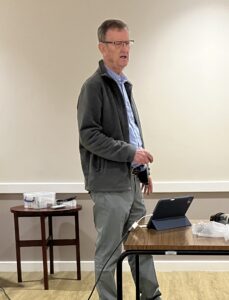
Tim Banks
Tim started off by assuring members that it wouldn’t be a particularly technical talk but would focus on the historical facts and their importance in the history of the world we inhabit today.
Tim himself had worked in electronics and telecommunications but spends his retirement as a volunteer at Manchester’s Museum of Science & Industry. It was a role solely attached to the replica working model of the original Manchester University ‘Baby’ Computer and he was tasked to talk to visitors, many of them from overseas, and to help them understand how it worked and explain its importance in the evolution of computing machines.
Tim showed a short BBC newsreel film from 1949 and commented that it was hard to imagine a time like that when computers just didn’t exist. A family’s only adventure in electronics then was via their home radio receiver listening mainly to the BBC. Some degree of mechanical number crunching did happen but in secretive establishments such as Bletchley Park which led the way during the war years with machines such as ‘Colossus’. Mathematicians otherwise used logarithm tables and slide rules to slowly work out complex tasks. In the early days of the introduction of computing into business and government the machines were often task specific, enormous in size and rather inflexible. But one over-riding problem was that these early machines had no memory in the same way as the human brain so the Manchester ‘Baby’ was the first attempt to solve that shortcoming.
The main individuals in the development of this new conceptual machine were Freddie Williams and Tom Kilburn. Both men from the North of England, Freddie Williams was from Romiley and studied at Stockport Grammar before progressing through Manchester University before WW2. Tom Kilburn was from Dewsbury in West Yorkshire and the two men met while on secondment at the Post Office Telecommunications Establishment during the war. After the war Freddie was asked to head up the Electronic Engineering Department at Manchester University and he persuaded Tom Kilburn to join him In the Mathematics area. Manchester also drew Max Newman away from Bletchley Park and eventually Alan Turing joined him in Manchester and they were complicit in creating the Computer Sciences Department. The Manchester ‘Baby’ machine relied on a cathode ray tube to store a limited memory but it was sufficient to prove that programmable memory was a viable concept for computing machines going forward. Eventually the Manchester team created the first magnetic computer disc drive.
Tim listed the Baby’s short specification data which was limited to a 32 bit number and the whole machine with many valves used 2.5 kilowatts of energy to run. The construction of the ‘Baby’ replica was helped by very limited records but a committee of individuals came to help the process including an engineer who had helped construct the original. As part of the build, the team were conscious of the need to source as many spare parts as possible to allow the ‘Baby’ replica to endure well into the future.
Wednesday 8th April 2026 – Bowling – Macclesfield 2/Alderley Edge v Knutsford Rex
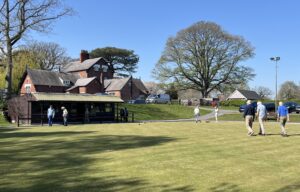
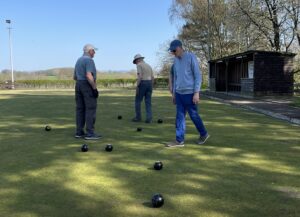
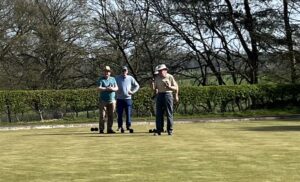
A warm sunny afternoon welcomed the bowlers to the most picturesque of greens at Siddington Village Hall. This year Macclesfield 2 Probus have joined forces with Alderley Edge Probus due to the dwindling of available players. So, it was an unknown challenge for the Rex team but they still showed their superiority by coming out with a victory of 74 points to 45. A special mention has to be made to the pairing of Trevor Bethell and Alan Allcock who were at the end of a 14-5 scoreline to come out victorious 15-14.
Thursday 2nd April 2026 – Walk – Astbury Country Park
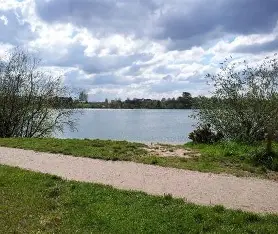
On a beautiful spring day the Group set off on a walk of about five and a half miles, a bit longer than usual. The route was along parts of the Macclesfield Canal & to enjoy a view of the Mow Cop. Turning back along the country lanes and on to the lake at the Country Park with the Astbury Church Spire always present as a distant point of reference. Afterwards the Group enjoyed a nice lunch at the Egerton Arms in Astbury.